
You have lived in your Plano home for years, and you plan to stay. The kitchen still works, mostly. But lately you notice things: you stretch for the casserole dish on the bottom shelf of a deep cabinet, you squint at the counter where one ceiling light leaves a shadow, and you have started stepping carefully over the little lip where the tile meets the next room. None of it is a crisis today. The real question is quieter: will this kitchen still work for me in ten years, and what should I change now rather than later?
If that sounds like you, this guide is written for you: a homeowner planning to stay put, who wants a kitchen that remains comfortable, safe and easy to use, without turning it into something that looks clinical.
The daily friction that tells you it is time to plan
Kitchens rarely fail all at once. They get harder in small ways. Common signs worth noticing:
- Bending or reaching for everyday items in deep, door-front base cabinets or high upper shelves.
- A tight walkway where two people, or one person with a laundry basket or walker-height support, cannot pass comfortably.
- Dim work areas that rely on a single overhead fixture.
- Floor transitions, thresholds or slick surfaces that make you watch your feet.
- Outlets that sit behind appliances or require leaning across a hot cooktop.
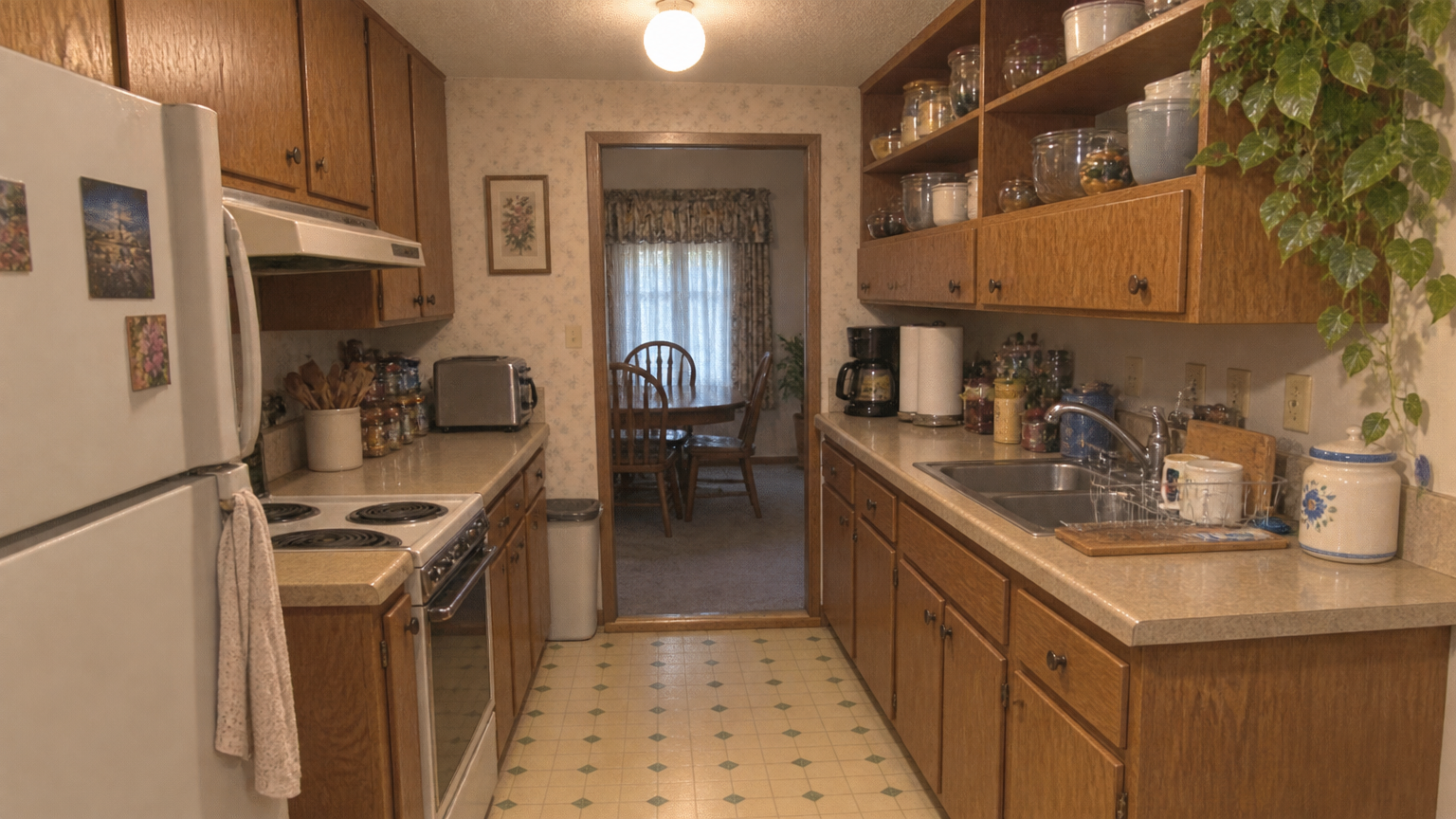
Here is a way to picture it. The first image shows an illustrative kitchen built in the 1990s, with exactly these pressure points.
Now versus later: sorting what to change
The most useful way to plan is to sort decisions by how hard they are to change later. This is a general planning approach, not a rule, and your own home and needs come first.
Changes that are easiest while walls and floors are open
These are the ones to think about early because they involve layout, plumbing, electrical and flooring:
- Walkway clearances. Moving an island or a cabinet run changes how much room you have to move. Ask a designer to walk the layout with you rather than guessing from a drawing.
- Lighting layers. Ceiling light, light under the upper cabinets and light at the sink are far easier to plan when electrical work is already happening.
- Outlet placement. Putting outlets where you can reach them without leaning over heat is a wiring decision.
- Flooring continuity. A continuous floor with no raised thresholds is simplest when the floor is being redone anyway.
- Plumbing locations. If you want the sink or fixtures somewhere different, that is a plumbing decision with ripple effects.
Changes that are easier to adjust later
- Cabinet hardware, such as larger pulls that are easier to grip.
- Small appliances and where you store them.
- Paint and decorative finishes.
This is where the trade-off lives. Planning for the future does not mean doing everything at once. It means making sure the hard-to-change decisions leave you room to adapt.
Comparing your options honestly
Most Plano homeowners in this situation end up choosing among three approaches.
1. Targeted upgrades
If your layout works and the cabinet boxes are sound, you may only need a few changes: better lighting, new countertops, or a smoother floor. Trident Kitchen Remodeling lists cabinet installation, countertop installation, kitchen tile installation and kitchen plumbing installation as separate services, so you can address one pain point without committing to a full gut. The trade-off: you may not fix layout or clearance issues.
2. Cabinet refacing
If the cabinet boxes are in good shape but the doors and finish are dated, cabinet refacing is one of the services Trident offers. It refreshes the look but keeps the existing footprint, so it will not widen a tight walkway or change how deep your base cabinets are. Worth knowing before you decide.
3. A full kitchen remodel
If the layout itself is the problem, a full remodel lets you rethink clearances, storage, lighting and flooring together. The trade-off is more disruption and a bigger decision. Trident's site says most complete kitchens run four to eight weeks, so ask for the schedule for your specific project during the planning conversation rather than assuming.
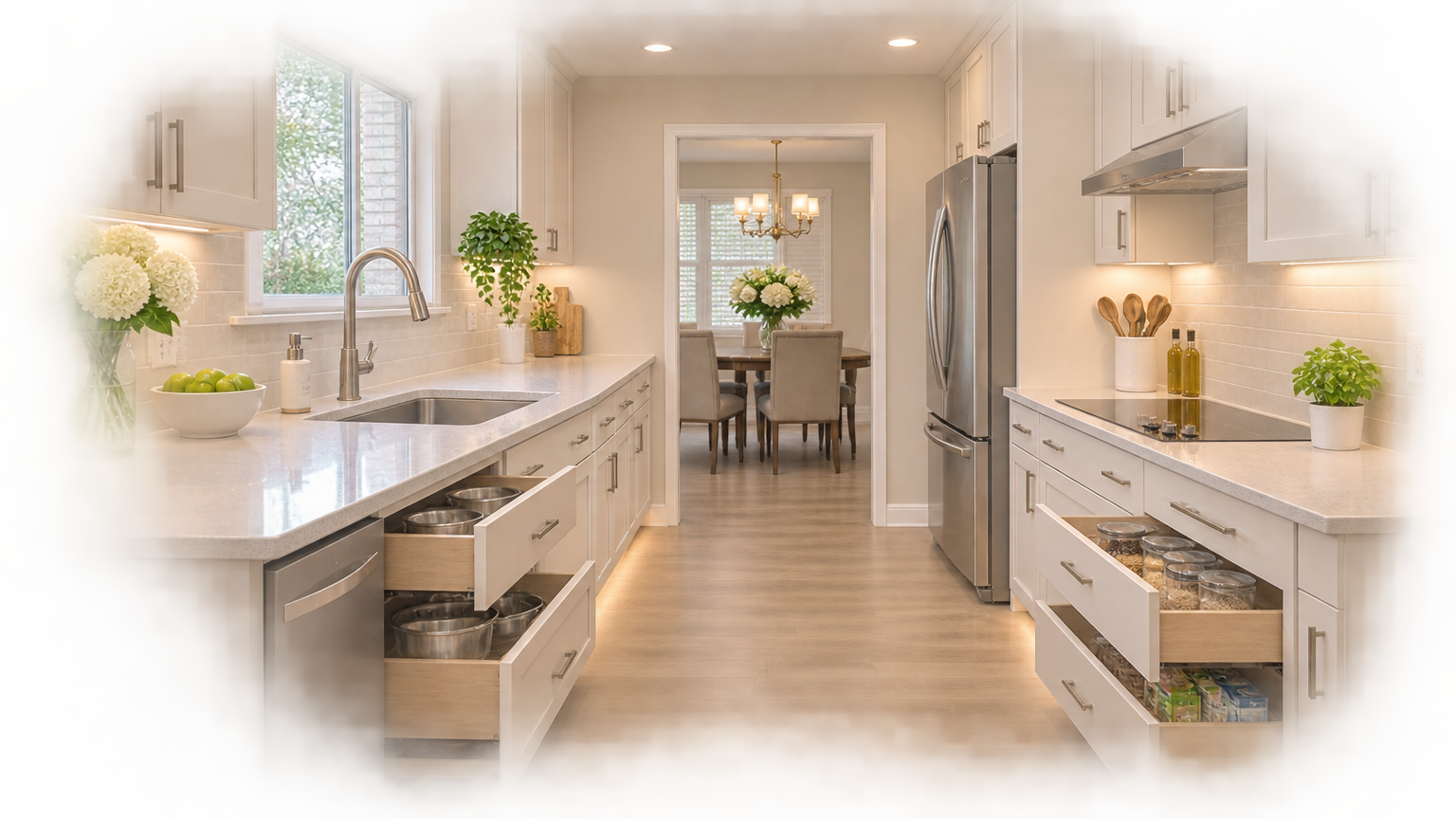
The illustration below shows what a rethought version of the same kitchen could look like, with a wider clear path, pull-out drawers, layered lighting and an even floor.
Questions to bring to a first conversation
Before you meet a contractor, jot down how you actually use the kitchen. Who cooks? Who helps? What do you reach for every day? Then bring questions such as:
- Which of these changes involve layout, electrical or plumbing, and how do they affect the plan?
- Will permits be needed, and who handles them? Trident's website states it pulls permits for every project and handles inspections with the City of Plano, but confirm how that applies to your scope.
- How will the proposal be written? Trident says it provides a clear, line-item written proposal after the in-home visit, which makes it easier to compare options.
- What does the workmanship warranty cover? Trident's site mentions a two-year workmanship warranty plus manufacturer warranties. Ask to see the terms in writing for your project.
Also check anything that matters to you personally: if you are planning around specific mobility or health needs, an occupational therapist or your doctor can help you define requirements, and a contractor can then design to them. Budget is a real part of this. Trident's site does not publish prices, so use the Cost Calculator on the site as a starting point and ask for an itemized proposal for real numbers.
Evaluating a contractor when you plan to stay
When this is the home you will live in for the long haul, judge a contractor on more than looks:
- Do they listen to how you live? A good first visit starts with your routines, not a catalog.
- Is the process clear? Trident describes a sequence of reaching out, an in-home visit, engineering and pricing, the build and a final walkthrough, and the owner, Paul Willi, conducts the in-home visit.
- Is the proposal itemized? It lets you decide what to do now and what to postpone.
- Are they local and accountable? Trident is based in Plano and is a division of Trident General Contracting, which the site says has built in North Texas since 1991.
Your next step
You do not need to decide everything today. A sensible next step is to spend a week noticing where your kitchen makes you stretch, squint or step carefully, and write it down. Then book the free in-home visit offered on the Trident Kitchen Remodeling website. The site says the visit is no-pressure and you receive a proposal either way. You can reach the team at (972) 309-9513 or through kitchen.tridentgcs.com.
A kitchen that is easier to use in ten years is usually the result of a few thoughtful decisions made now. Start with the ones that are hardest to change later, and the rest can follow at your pace.
Thinking about your own kitchen?
Book a free in-home visit with Paul and get a clear written proposal.
Book a Free Consultation